Chapter 6 Enterprise Blueprint • Single-Lot Unit Economics
How to Operate an Agricultural Spraying Drone Business in India
Battery rotation economics, DGCA pilot licensing, Namo Drone Didi / FPO service contracts, and per-acre spraying margins.
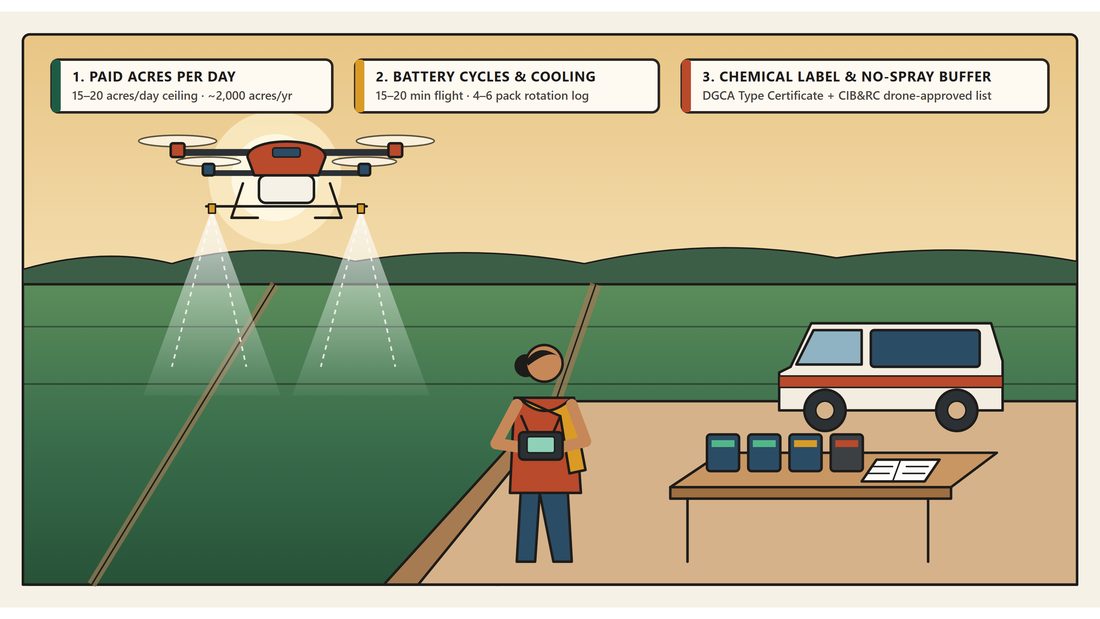
Estimated Starting Equipment / Capex
₹35,000 – ₹90,000 (DGCA Remote Pilot Certificate + extra battery/generator kit to operate an FPO, IFFCO, or CHC-owned agri-drone)
Single-Lot Validation Batch
15–20 acres sprayed per morning/evening wind window
1. How the Margin Works (The Missing Step)
A ₹8–10 lakh agricultural drone sits idle when an organization lacks a licensed pilot, fast-charging generator logistics, and village clustering. Operating the drone on a per-acre revenue share (₹300–₹450/acre service fee) turns battery management into a cash-positive service.
2. The Hard Stop-Loss Rule
Never fly with fewer than 4 working battery sets and a field generator; if daily sprayed area averages under 8 acres per operational day due to battery wait times, unit economics fail.
3. Eligible Government Subsidies, Loans & Technical Labs
Namo Drone Didi Scheme (80% subsidy up to ₹8 lakh for SHGs), SMAM FPO Drone Grants (up to 75%), RPCAU Pusa & BAU Sabour DGCA Drone Pilot Training.
Frequently Asked Questions
How many acres can one agri-drone spray in a day in Indian smallholder fields?
With 4 to 5 lithium battery sets, a 3.5 kVA field generator for rapid charging, and contiguous pre-mapped plots, a trained pilot and co-pilot can cover 15 to 22 acres across the morning and late-afternoon low-wind windows.
Get the Complete Step-by-Step Ledger, Vendor Specs & 97-Institution Directory
Every chapter in The Missing Step includes the complete single-lot cost table, buyer contract checklist, 30-day launch calendar, and matching funding schemes from The Missing Step Directory.
Explore All 11 Agribusiness Blueprints
- Ch 2: Shared Makhana Processing Shed
- Ch 3: Same-Day Vegetable Collection Door
- Ch 4: Crate-Level Solar Cold Room
- Ch 5: Custom Hiring Seed Drill by the Acre
- Ch 7: Sensors That Prevent One Total Loss
- Ch 8: Counted Fingerlings, Nearer Feed & Ice
- Ch 9: Seed Multiplication for a Contracted Buyer
- Ch 10: Digitize the Milk Chain That Already Pays
- Ch 11: Keep the Small Animal Alive, Then Sell It
- Ch 12: Sell a Changed Practice, and the File Someone Pays For